The kiosk gives the desk back to conversation
A self-service kiosk lets a borrower issue and discharge items on their own. Because the items carry RFID tags, the borrower puts a whole stack on the plate: every item is identified at once, security is de-armed, and a receipt prints or is emailed. The transaction takes seconds and needs no staff intervention. The kiosk does not replace your LMS, it asks it for permission over SIP2 or NCIP.
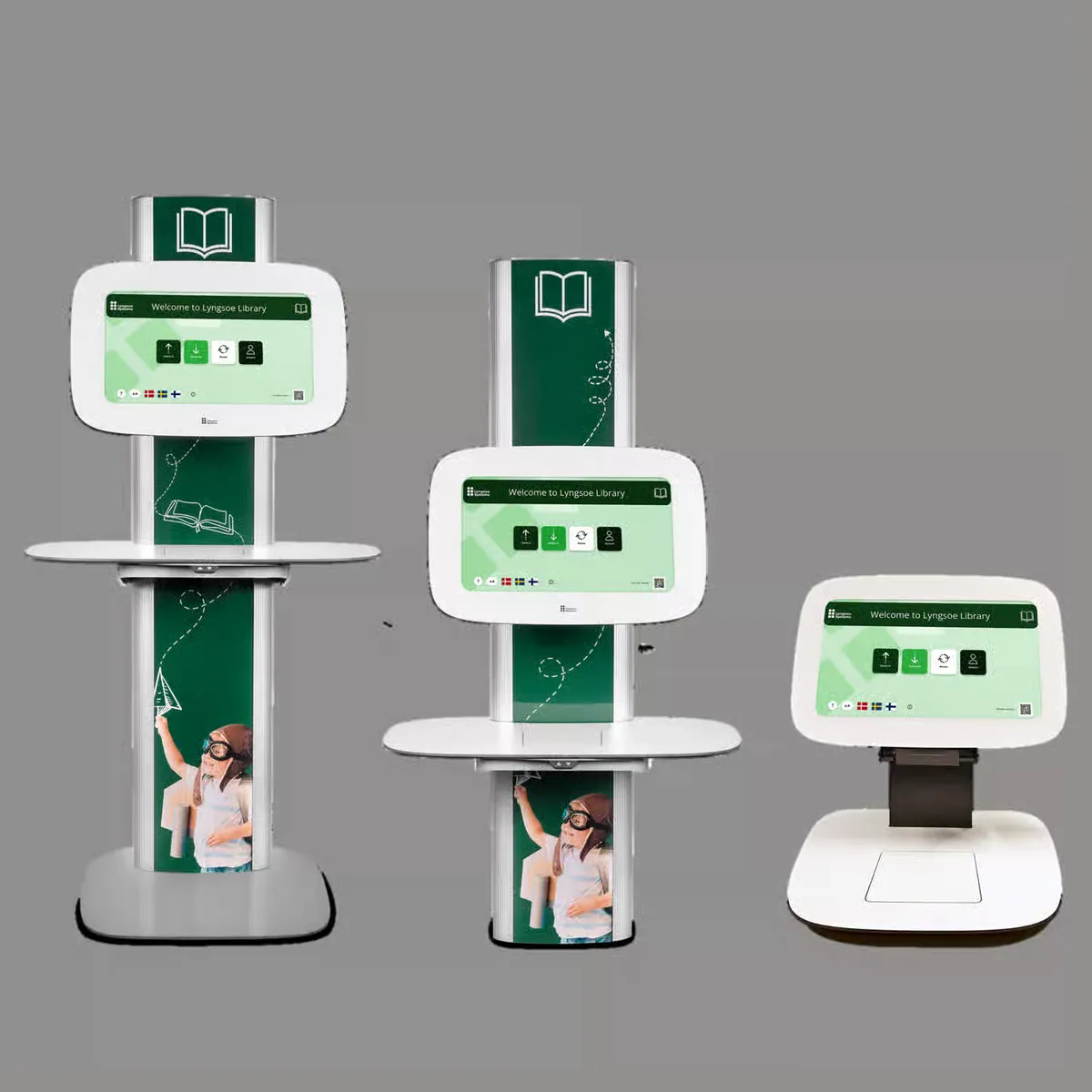
The difference is where it stands
All four share the same 22 inch touchscreen, the same LibRid4 software and the same plate. What separates them is the installation and the working height.
- F20, floor-standing, plate adjustable from 590 to 1,090 mm. The reference model.
- F10, floor-standing, plate fixed at 900 mm. Simpler, fewer moving parts.
- W20, wall-mounted with height adjustment. No footprint at all.
- T10, countertop, 26 kg. Sits on furniture you already own.
Full specifications for each are on the equipment page.
How a transaction actually runs
- The borrower identifies themselves with a barcode card, a contactless card, a phone or a typed identifier, depending on your configuration.
- They place the items on the plate. The RFID antenna reads every tag in its field.
- The kiosk queries the LMS over SIP2 or NCIP. Is this borrower entitled, is this item lendable, is there a hold on it ?
- The LMS approves and records the loan. It, and it alone, holds the transaction.
- The kiosk de-arms security on each item, by flipping the security bit or the AFI value on the tag, then issues the receipt.
If the network drops or the LMS does not answer, the kiosk refuses the transaction rather than creating an inconsistency. That is deliberate. Sending a borrower back to the desk is better than recording a phantom loan that nothing can reconcile afterwards.
Accessibility, which comes up in every tender
And rightly so. The points that matter are the height of the plate and of the screen for a wheelchair user, the contrast and character size of the interface, audio guidance, and the number of interface languages. The LibRid software offers two font sizes and several contrast levels.
Two models carry a height adjustment that the manufacturer states as ADA and DDA compliant: the F20 floor-standing unit, over a 500 mm travel, and the W20 wall unit. If you are installing a single kiosk, take an adjustable one. The extra cost is nothing next to a second station, and a fixed-height single kiosk will come back at you in an accessibility review.
On the software side, we publish the manufacturer's measured conformance figures, including the failures, on our accessibility page. We would rather you read them here than discover them at acceptance testing.
How far does take-up actually go ?
This is the question staff ask, and fairly: what use is a kiosk if nobody uses one. Observed rates run higher than most people expect, provided the kiosk is visible and well placed.
Worcestershire Libraries in the United Kingdom publish a figure worth quoting as part of their extended access scheme: more than 95 % of returns and renewals are handled in self-service or online. Over the same period weekly opening hours grew by 59 %, and 130,263 visits were recorded outside staffed hours between June 2022 and November 2025.
Figures published by Lyngsoe Systems on the Worcestershire Libraries case. These are UK network figures under an extended-access scheme: they show what is achievable, not what is guaranteed in your building. For a first calculation, 60 % is a prudent assumption.
Related pages
Returns and sorting
Return units that accept items when you are closed, and a modular sorter at up to 2,400 items per hour
Read →Security and inventory
RFID gates up to 1,600 mm of aisle with built-in radar counting, and a 600 g handheld reading up to 30 tags…
Read →Equipment
Eighteen Lyngsoe Systems products with their dimensions, throughputs and standards: kiosks, return units,…
Read →What people ask first
How many items can be issued at once ?
In practice a stack of eight to ten ordinary items reads without difficulty. The exact number depends on thickness and on what the items are made of: optical media and anything containing metal or foil read poorly in a stack and may need a booster tag.
Will it work with our LMS ?
Yes, provided your LMS exposes SIP2, NCIP or a REST API. That covers Koha, Alma, Sierra and the main French systems. Your vendor enables the interface at their end, usually without a licence surcharge, and that step is more often the critical path than anything on our side.
Should we remove the staffed desk ?
No, and it is rarely a good idea. The aim is to move routine transactions to self-service so that staff handle what needs them: registrations, enquiries, support. The libraries that get the most out of RFID are the ones that redeploy that time rather than closing the service point.
What about payment of fines ?
A side-mounted payment module is offered as an option. Whether it takes cash or card, and how it reconciles with your finance rules, needs settling with your finance office before you order. That question delays more projects than any technical one.
Unsure about one specific point ?
Ask it the way it arises in your building. We answer on your configuration rather than in general terms.