The Monday backlog that is already dealt with
A return unit accepts items when the library is closed, identifies each one, re-arms its security, updates the borrower's account in the LMS, and sends the item either into a bin or straight onto a sorter. A sorting line then routes each item to its destination at up to 2,400 items per hour. By opening time the returns are checked in, secured and already separated by section or by branch.
What happens between drop-off and shelf
Four stages separate the borrower's gesture from the reshelving trolley. The important one is not the sorting: it is the catalogue update, which happens much earlier.
Three exposures, three models
The models differ by where they can be installed rather than by what they do.
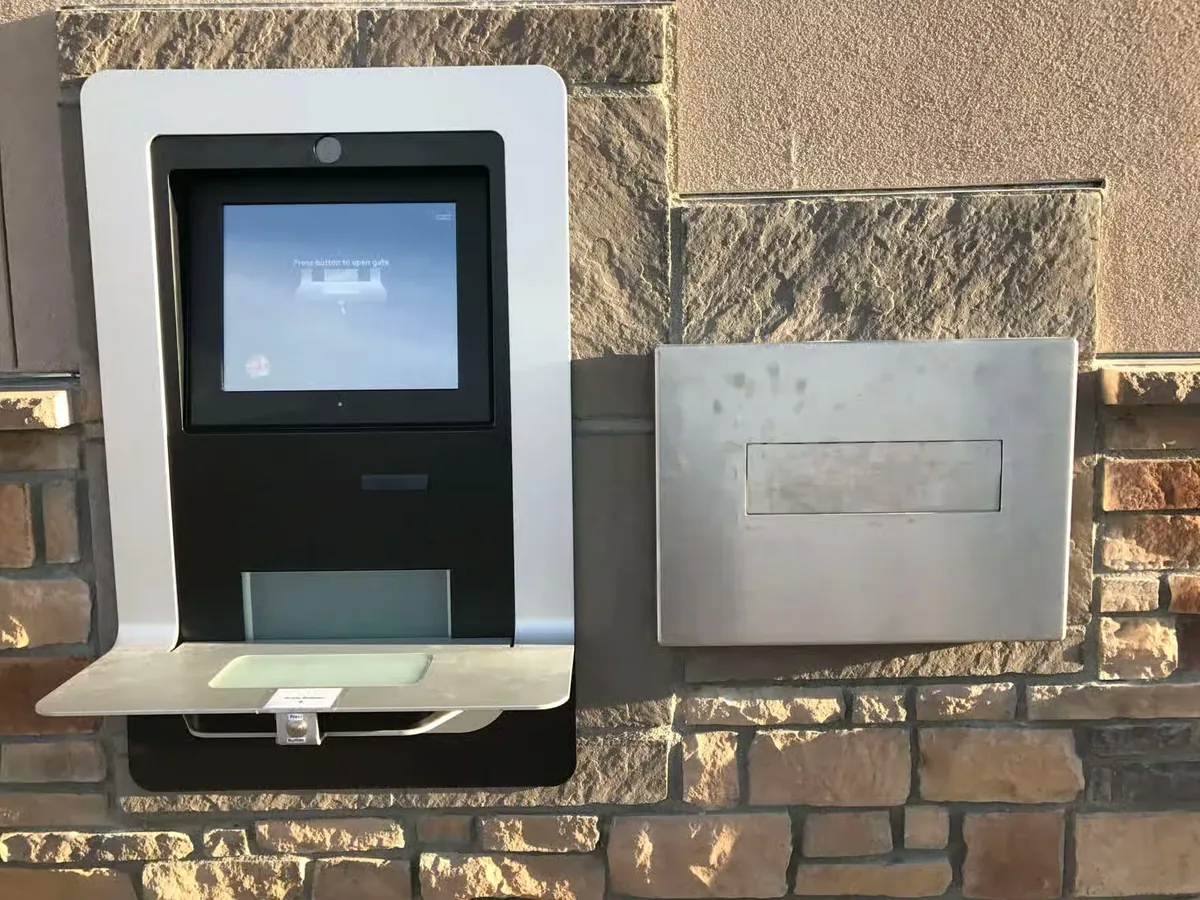
Indoors, the Library Mate 1200 takes up to 1,100 items per hour through an 800 mm tunnel, with a 19 inch screen. For oversized stock, the 1300 C2 widens the tunnel to 400 mm, which matters more than it sounds: measure ten picture books from your children's section before you decide. Outdoors, the 2100 is set into the facade and takes returns around the clock.
An outdoor unit is a building project, not a delivery. It means an opening in the facade, an owner's consent, often a planning notification, and in a conservation area the heritage architect's opinion. Start that clock as soon as the position is fixed.
When a sorter is not worth buying
We would rather say this before you order than after. A sorter is rarely economic below a certain flow, and that threshold sits higher than most people assume.
A sorter does not save time on the return itself. The return unit already automated that. It saves time on manual pre-sorting: the stage where somebody separates items by section, by branch or by status before reshelving. In a single-site library with three sections that stage is a handful of hours a week, and the investment does not come back.
It earns its place in three situations. A network that vans items between sites, where sorting by destination is daily work. A heavily segmented collection with many shelving categories. A high return volume concentrated into a few hours, where the peak overwhelms the team.
The constraint is length, not throughput
2,400 items per hour comfortably exceeds what a mid-sized public library produces in a full day, so throughput is almost never the limiting factor.
What limits you is linear metres. Each destination adds 600 mm of line, plus the bin, plus the circulation space to take it away. A line with eight destinations occupies a room, not a corner of the store.
The practical consequence is simple: reserve the maximum length you will ever reach, even if you install three modules now. The libraries that regret their sorter are almost always the ones that can no longer extend it.
Counting destinations: add your shelving sections, your branches, and reserve two service outlets, one for holds and one for rejects and exceptions. A five-section library serving two branches therefore needs nine, not five.
Related pages
Security and inventory
RFID gates up to 1,600 mm of aisle with built-in radar counting, and a 600 g handheld reading up to 30 tags…
Read →Equipment
Eighteen Lyngsoe Systems products with their dimensions, throughputs and standards: kiosks, return units,…
Read →LMS integration
How RFID equipment talks to a library management system: what SIP2 carries, what NCIP adds, what neither…
Read →Points worth clearing up
Can several items be returned at once ?
No, a return unit handles items one at a time. That is necessary in order to individualise each one and route it to the right destination. Batch reading happens at issue, on a kiosk, where the items stay together.
What happens when the bin is full ?
The unit detects it and refuses further deposits, showing the reason on screen. This is the first capacity to size properly: calculate the volume of a long weekend, not of an ordinary night. An undersized bin is the leading cause of an out-of-service outdoor return unit.
Is the sorter noisy ?
It produces conveying and diverting noise, plus the impact of the item landing in the bin. That is acceptable in a plant room and questionable next to a reading room. Noise levels in dB(A) are not published on the datasheet, so we request them from the manufacturer case by case when the line adjoins a public space.
Who sets the sorting rules ?
You do. The Sorter Controller is a web application that lets you create an unlimited number of sorting tables, activate and deactivate them, and import or export them. A library that changes its rules every school holiday does so itself, with no call to the manufacturer.
What happens to items the sorter cannot identify ?
They go to a rejects outlet, which we always plan for. The usual causes are a missing, detached or badly encoded tag, or an item belonging to another library. The reject rate is a good measure of how well your collection was tagged.
Tell us about your library
Collection size, annual transactions, the LMS you run and your timescale. Four figures are enough for us to say what is relevant to you, and what is not.